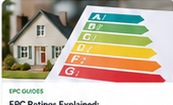

“What’s the minimum EPC rating I need?” — the answer depends entirely on whether you’re selling or letting, and half the confusion I hear comes from mixing the two up. Here’s the 2026 position, plainly, for both.
EPCRATE Services — Quick Links
Is there a minimum EPC rating to sell a home?
No. There is currently no minimum rating to sell — even an F or G property can legally be sold. What the law does require when selling:
- A valid EPC before the property is marketed
- The rating shown on property listings
- A copy given to the buyer before completion
That said, a poor band increasingly costs sellers in other ways — buyers factor in upgrade costs, and some lenders look harder at inefficient properties. No minimum doesn’t mean no consequence.
What is the minimum EPC rating to rent out a home?
Band E. Under the MEES regulations (the Energy Efficiency (Private Rented Property) Regulations 2015), a privately rented home in England and Wales must be rated E or above:
- A–E → legal to let
- F or G → unlawful to let unless a valid exemption is registered
This applies to new and existing tenancies. The full landlord picture — cost caps, enforcement, planning for what’s coming — is in our MEES compliance guide for London landlords.
What happens if a rental home is rated F or G?
The landlord must either improve the property to band E — spending up to the £3,500 cost cap (inc VAT) — or register a valid exemption on the PRS Exemptions Register. Letting it regardless risks penalties of up to £5,000 per property, enforced by local authorities, plus publication of the breach. In my experience the first step should always be checking whether the rating is even right: F and G certificates built on default assumptions (unverified insulation, unidentified boilers) are common, and sometimes evidence alone lifts the band.
Are the minimum EPC requirements changing?
The minimum for rentals remains band E in 2026. The government has confirmed its intention to raise the standard to EPC C (or equivalent) by 2030 — with compliance proposed from 1 October 2030 and a higher £10,000 cost cap. This is a proposal, not yet law, but the direction is clear. If your rental sits at D or E today, planning improvements gradually will beat scrambling in 2029 — a Draft EPC shows which works would actually move your band before you spend anything.
Which exemptions apply to the minimum rating?
All must be registered on the PRS Exemptions Register — none are automatic:
- All relevant improvements made, but band E still can’t be reached (5 years)
- High cost — band E unreachable within the £3,500 cap (5 years)
- Wall insulation would damage the property (5 years)
- Third-party consent refused (5 years)
- Devaluation — works would cut the value by more than 5% (5 years)
- New landlord (6 months)
Our step-by-step guide to registering an EPC exemption covers the process and evidence.
Minimum EPC ratings — quick answers
Can I sell a house with an F or G EPC rating?
Yes — there’s no minimum rating for sales. You just need a valid EPC before marketing and to give it to the buyer.
What is the minimum EPC rating for rental properties in 2026?
Band E. Letting an F or G property is unlawful without a registered exemption. A rise to band C by 2030 has been proposed but is not yet law.
How much do I have to spend to reach band E?
Up to the £3,500 cost cap (inc VAT). If band E still can’t be reached within it, you can register a high-cost exemption.
Need to know where your home stands? Book an assessment from £59 or call 020 3488 4142 — all 32 London boroughs. Rated ★★★★★ on Google Reviews and rated Excellent on Trustpilot.


Written by Jinoy Jose
DEA Accredited Energy Assessor · EPCRATE, London · Founded 2015
Jinoy Jose is the founder of EPCRATE and an accredited Domestic Energy Assessor (DEA). He has carried out thousands of EPC assessments across all 32 London boroughs since 2015, with NDEA-accredited assessors at EPCRATE covering commercial properties.
Last updated: · About the author →