Most homeowners, landlords and property buyers have heard of an Energy Performance Certificate (EPC), but surprisingly few people have actually taken the time to understand what the document contains.
EPCRATE Services — Quick Links
Whether you are selling a property, buying a home, applying for a mortgage or preparing a rental property, understanding how to read an EPC can help you make more informed decisions.
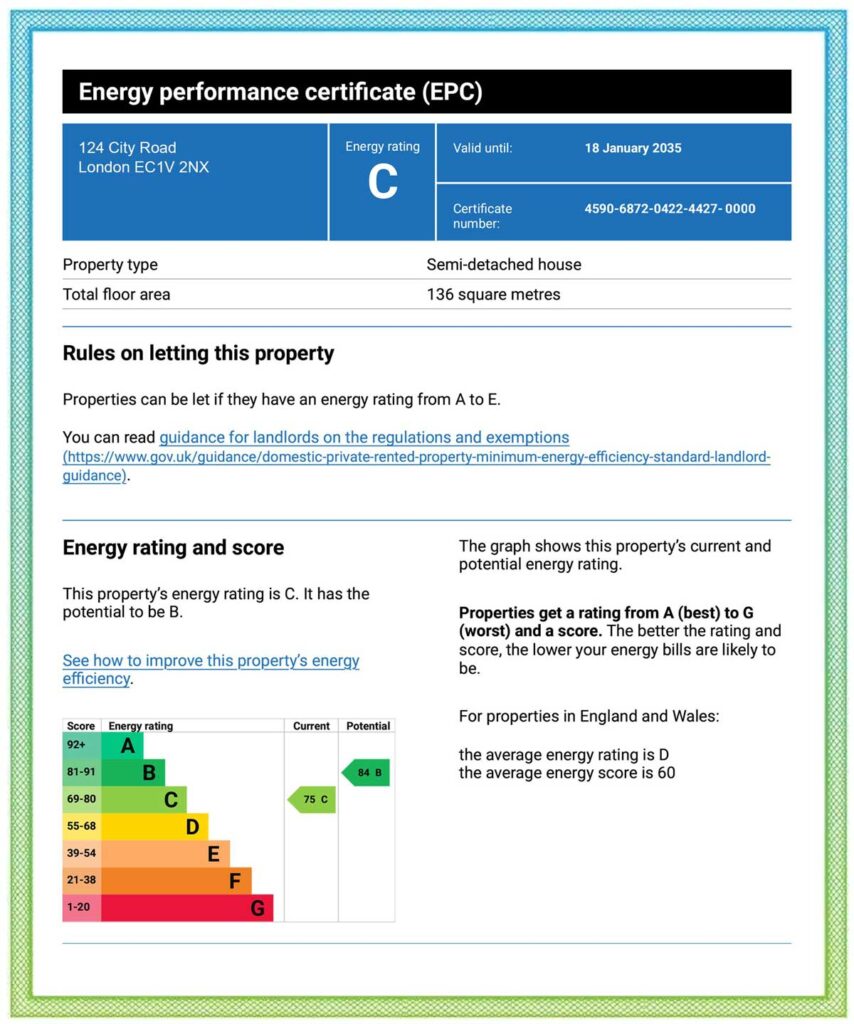
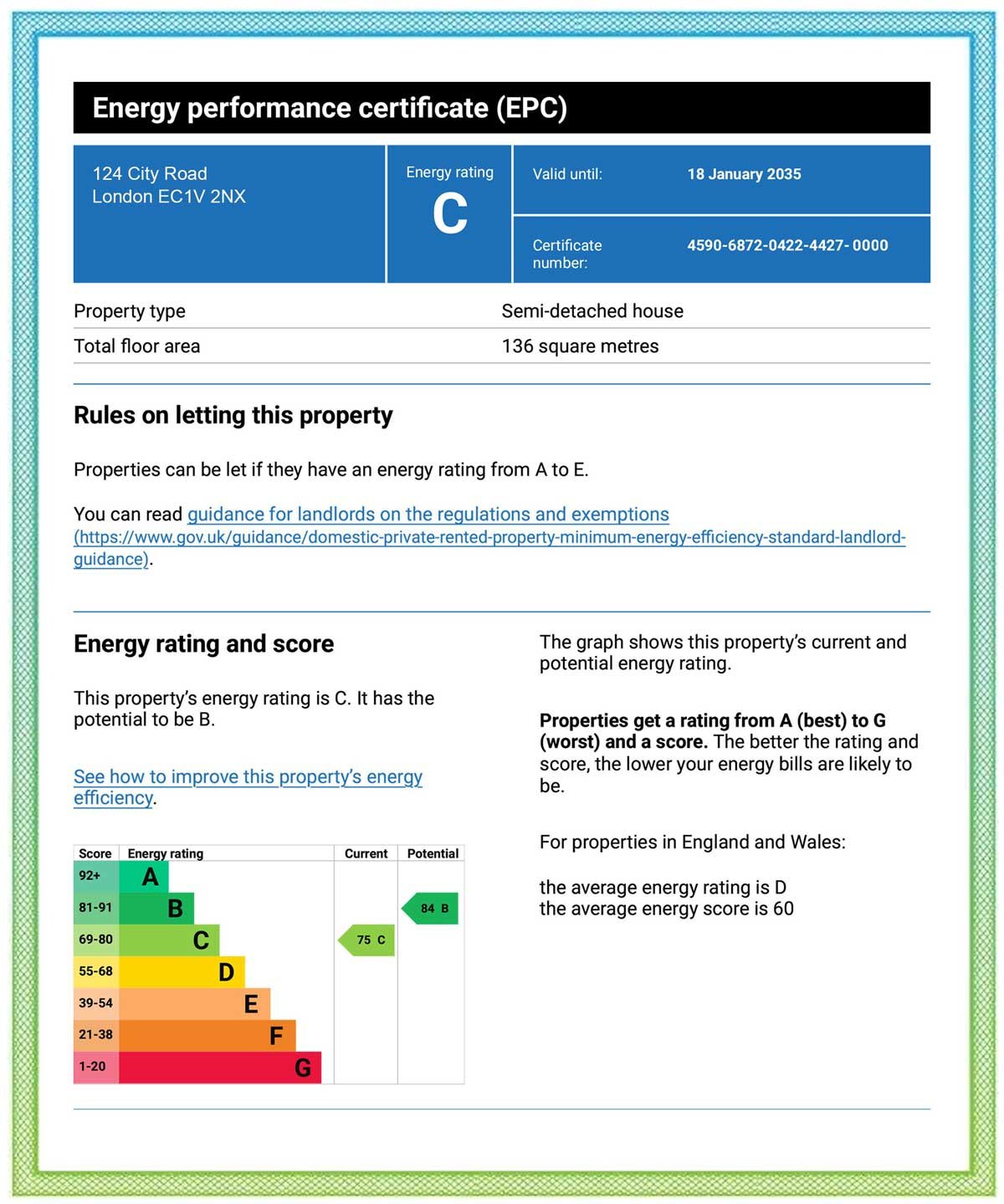
In this guide, we walk through a real EPC certificate and explain what each section means.
What Is an EPC?
An Energy Performance Certificate measures the energy efficiency of a property and provides a rating from A (most efficient) to G (least efficient).
The certificate is produced using government-approved assessment methodologies and provides information about the building’s energy performance at the time of assessment.
Domestic EPCs generally remain valid for 10 years from the date they are issued.
The EPC Rating Graph Explained
The most recognisable section of an EPC is the coloured rating graph.
This displays:
- Current EPC rating.
- Potential future rating.
- Energy efficiency score.
- A-to-G performance bands.
The current rating reflects the property’s assessed performance at the time of inspection.
The potential rating estimates how the property could perform if recommended improvements were completed. To understand what each band means, see our guide to EPC bands explained.
Potential ratings are illustrative only and do not guarantee future outcomes.
Current and Potential Ratings
Many property owners focus on this section first.
You will usually see:
- Current rating.
- Potential rating.
- Numerical SAP score.
The difference between the two figures indicates the scope for possible improvement based on the assessment methodology.
Estimated Energy Costs
The certificate includes modelled estimates relating to energy costs.
These figures are generated using standard assumptions and are intended for comparison purposes.
Actual household energy bills may differ significantly depending on:
- Occupancy levels.
- Energy prices.
- Heating habits.
- Property usage patterns.
Environmental Impact Rating
The EPC also includes an Environmental Impact Rating.
This reflects the estimated carbon emissions associated with the property.
Like the Energy Efficiency Rating, it is displayed on an A-to-G scale.
This section can be particularly relevant to environmentally conscious buyers, investors and lenders.
Recommended Improvements Section
Most EPCs contain a list of recommended improvements.
Examples may include:
- Loft insulation.
- Wall insulation.
- Heating controls.
- Low-energy lighting.
- Renewable technologies.
These recommendations are generated by the assessment software and should not be interpreted as personalised retrofit advice.
Property owners should always consider suitability, cost and practicality before undertaking any works. Our guide to EPC improvement costs covers what different measures typically involve.
Why EPC Recommendations Sometimes Seem Strange
One of the most common questions we receive is:
“Why has my EPC recommended something that already exists?”
In many cases, this happens because:
- The feature could not be evidenced.
- The feature could not be verified.
- The recommendation is generated automatically.
- The software uses standard assumptions.
This is one reason why supporting evidence can be extremely important. To understand how the score is produced, see our guide on how an EPC is calculated.
Why Evidence Matters
Many energy efficiency improvements become hidden once installed.
Examples include:
- Floor insulation.
- Internal wall insulation.
- Cavity wall insulation.
- Certain heating upgrades.
Useful evidence may include:
- Building Control approvals.
- FENSA certificates.
- Insulation certificates.
- MCS certificates.
For concealed measures such as floor or internal wall insulation, documentary evidence is typically needed — usually Building Control sign-off, or builder documentation and architect’s drawings with invoices as backup. Where improvements cannot be evidenced, assessors may be required to use default assumptions under RdSAP conventions. See our guide to what evidence can improve EPC accuracy.
How a Draft EPC Review Can Help
Many landlords, investors and homeowners use EPCRATE’s Draft EPC Review service before committing to expensive improvement works.
This can help review:
- Current EPC position.
- Available evidence.
- Potential improvement pathways.
- Budget priorities.
A Draft EPC Review does not guarantee a future EPC rating or compliance outcome.
Why Choose EPCRATE?
- Founded in 2015 by Jinoy Jose, DEA accredited.
- NDEA-accredited assessors for commercial properties.
- Rated Excellent on Trustpilot.
- ★★★★★ Google Reviews.
- Coverage across all London boroughs.
- Domestic and Commercial EPC specialists.
- Draft EPC Review Service available.
- EPC & Floor Plan Bundles available.
- Greater London Energy Efficiency Awards – Commended 2024.
- Greater London Energy Efficiency Awards – Highly Commended 2025.
Frequently Asked Questions
What does the EPC rating graph show?⌄
It shows the property’s current energy efficiency rating and its potential rating on the A-to-G scale, along with the numerical energy efficiency score.
What is the difference between the current and potential rating?⌄
The current rating reflects the property as assessed on the day. The potential rating estimates how it could perform if the recommended improvements were completed — it is illustrative and not guaranteed.
Are the estimated energy costs on an EPC accurate?⌄
They are modelled using standard assumptions for comparison purposes. Actual bills can differ significantly depending on occupancy, energy prices and how the property is used.
Why does my EPC recommend an improvement I already have?⌄
Usually because the feature could not be evidenced or verified on the day, so the software applied a default assumption. Supporting documentation can help avoid this.
How long is an EPC valid?⌄
A domestic EPC generally remains valid for 10 years from the date of issue.
Need an EPC in London?
EPCRATE provides Domestic EPCs, Commercial EPCs, Floor Plans and Draft EPC Reviews across all 32 London boroughs. Next-day appointments are available from £59, with urgent same-day inspections from £90 (certificate issued on site) subject to availability.
Call 020 3488 4142 to discuss your property, or book your EPC assessment online.
Final Thoughts
An EPC is much more than a coloured chart.
Understanding what the certificate actually shows can help property owners make better decisions when selling, renting, renovating, remortgaging or investing.
The most important lesson is that EPC ratings depend not only on the property itself but also on the evidence available to support qualifying improvements.


Written by Jinoy Jose
DEA Accredited Energy Assessor · EPCRATE, London · Founded 2015
Jinoy Jose is the founder of EPCRATE and an accredited Domestic Energy Assessor (DEA). He has carried out thousands of EPC assessments across all 32 London boroughs since 2015, with NDEA-accredited assessors at EPCRATE covering commercial properties.
Last updated: · About the author →