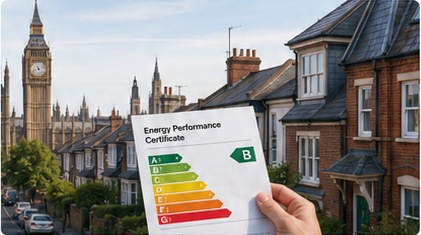

Most advice on improving an EPC is generic. This guide is based on something more specific: the survey records from 192 London homes assessed by EPCRATE founder Jinoy Jose (DEA, Elmhurst Energy accredited). It shows what London homes actually scored, how far they could go, and which improvements came up again and again.
EPCRATE Services — Quick Links
About the data
- 192 London homes (111 flats, 67 houses and 14 maisonettes) surveyed in 2019 and 2020, mostly for sales (85%) and lettings (15%).
- Figures are aggregated counts only: no address, owner or individual property can be identified from this article.
- The surveys used the RdSAP methodology in force at the time (SAP 9.93). The methodology was updated in 2025 (RdSAP 10), which changes how some items, such as lighting, are scored, so treat the exact percentages as a guide rather than a forecast for your home.
How London homes scored
| EPC band | Homes now | Potential after recommended measures |
|---|---|---|
| B (81–91) | 17 (9%) | 94 (49%) |
| C (69–80) | 93 (48%) | 92 (48%) |
| D (55–68) | 68 (35%) | 6 (3%) |
| E (39–54) | 10 (5%) | 0 |
| F or G (1–38) | 4 (2%) | 0 |
- The typical (median) home scored 69, right on the C/D boundary, with a potential of 80.
- 82 homes (43%) were below C. Of those, 76 (93%) could have reached C or better if the recommended measures were carried out.
- Only 14 homes (7%) were rated E or worse.
Houses vs flats: where the headroom is
| Houses (67) | Flats (111) | |
|---|---|---|
| Typical current score | 66 (D) | 73 (C) |
| Typical potential score | 84 (B) | 79 (C) |
| Rated below C | 47 (70%) | 29 (26%) |
Flats start higher because they lose less heat: neighbours above, below and beside act as insulation. That also means there is less to gain. Houses, especially London’s Victorian and Edwardian terraces with solid brick walls, start lower but have the most room to improve.
The improvements that came up most often
| Measure | Recommended in | Already in place |
|---|---|---|
| Solid wall insulation (internal or external) | 81 homes (42%) | 0 |
| Low-energy lighting | 81 homes (42%) | 95 homes (49%) |
| Solar photovoltaic (PV) panels | 67 homes (35%) | 0 |
| Solar water heating | 57 homes (30%) | 0 |
| Floor insulation (suspended timber floor) | 45 homes (23%) | 0 |
| Floor insulation (solid floor) | 31 homes (16%) | 0 |
| Cavity wall insulation | 30 homes (16%) | 65 homes (34%) |
| High heat retention storage heaters | 30 homes (16%) | – |
| Boiler upgrade (same fuel) | 27 homes (14%) | 111 homes (58%) |
| Double glazing | 27 homes (14%) | 163 homes (85%) |
| Heating controls (programmer, room thermostat, TRVs) | 25 homes (13%) | 91 homes (47%) |
What this means if you are selling
1. Most London homes have already done the obvious things
85% already had double glazing, 89% had draught-proofing and 58% had an efficient boiler. If your home is one of them, replacing windows or the boiler just for the EPC is unlikely to be good value.
2. Cheap wins still matter
Low-energy lighting was recommended in 42% of homes and heating controls in 13%. These are low-cost jobs that can be done in days. The 2025 methodology scores lighting differently (it now looks at the actual bulbs fitted), so do not expect lighting alone to change a band, but combined with heating controls and a loft top-up it can be enough to tip a borderline D into a C.
3. The big points cost big money
Solid wall insulation (42% of homes) and solar panels (35%) are the measures that move ratings most, but they are expensive and disruptive, and rarely pay back before a sale. They make more sense if you are staying, or if you are a landlord who needs to meet minimum standards. See our MEES guide for landlords.
4. Evidence can be worth more than new work
Where an assessor cannot see or verify something (insulation under floors or in walls, for example), the methodology falls back on default assumptions based on the age of the property, which are often pessimistic. Installation certificates, receipts and photos of loft or wall insulation can lift a rating without any new work. Read which documents improve EPC accuracy.
5. Check before you spend
Because every home is different, the safest first step is a Draft EPC: we assess the property and show you which improvements would lift the rating, by how much, before anything is lodged. For lower-cost ideas, see how to improve your EPC rating without overspending.
Frequently asked questions
How many points can I add to my EPC before selling?
In our sample of 192 London homes the typical home could gain about 10 points (from 69 to 80). Houses had more headroom: the typical house scored 66 with a potential of 84, while the typical flat scored 73 with a potential of 79.
Can most London homes reach an EPC C?
In our data, 93% of homes rated below C could have reached C or better with the recommended measures, though for some that meant expensive work such as solid wall insulation.
What is the cheapest way to improve an EPC?
Low-energy lighting, heating controls (programmer, room thermostat and TRVs) and topping up loft insulation are the usual low-cost options, along with giving the assessor evidence of insulation or upgrades already installed.
Do I need a minimum EPC rating to sell my house?
No. There is no minimum rating to sell in England and Wales, but you must have a valid EPC before you market the property. Landlords must meet a minimum E rating to let.
Need an EPC or a Draft EPC in London? Domestic EPCs from £59, certificate within 24 hours. Book online or call 020 3488 4142.


Written by Jinoy Jose
DEA Accredited Energy Assessor · EPCRATE, London · Founded 2015
Jinoy Jose is the founder of EPCRATE and an accredited Domestic Energy Assessor (DEA). He has carried out thousands of EPC assessments across all 32 London boroughs since 2015, with NDEA-accredited assessors at EPCRATE covering commercial properties.
Last updated: · About the author →