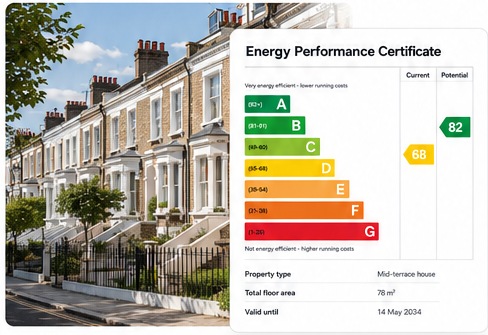

Most of the questions I get asked about domestic EPCs come down to the same handful: what is it, do I need one, how long does it last, and what happens if I let without one. I lodge EPCs across London every week, so let me answer them the way I would if you rang the office.
EPCRATE Services — Quick Links
What is a domestic EPC certificate?
A domestic Energy Performance Certificate is the official document that shows how energy-efficient your home is. It gives you three things: an energy efficiency rating from A (most efficient) down to G, an estimate of your heating, lighting and hot-water costs, and a list of improvements that would lift the rating. It’s produced by an accredited domestic energy assessor (DEA) and lodged on the national EPC register. Every EPCRATE assessment is carried out by me — Jino Jose, DEA-accredited — more about our London EPC practice here.
Who needs a domestic EPC in 2026?
You legally need a domestic EPC if you’re selling a home, letting one to new or existing tenants, or even just marketing it for sale or rent. That last one catches people out — the EPC has to be ordered before the listing goes up, not before completion. Landlords also have to meet the Minimum Energy Efficiency Standards (MEES) before letting — I’ve covered that in full in our MEES compliance guide for London landlords. And if a sale or tenancy is about to complete and you need the certificate today, we run a same-day EPC service across London.
How does the EPC assessment process work?
Four steps, and the visit itself is easier than most people expect.
How do I book an EPC assessment in London?
Book online or call 020 3488 4142 — check the EPC pricing first if you like; a studio or one-bed starts at £59.
What does the assessor actually inspect?
The visit is non-intrusive and usually takes 30–60 minutes. I record the floor area and property age, wall construction (solid or cavity), loft insulation where I can see it, glazing type, the heating and hot-water system, and the fixed lighting. Here’s the thing about London housing stock: in a Victorian terrace with solid walls, or a converted flat where the loft belongs to the freeholder, I often can’t physically inspect what owners assume I can. When I can’t evidence something, the software has to use default assumptions — and defaults usually score worse than reality. So dig out your paperwork before I arrive: FENSA certificates, Building Control sign-offs, boiler documentation. It genuinely changes ratings.
How is the EPC rating calculated?
Everything I record goes into the government-approved RdSAP software, which calculates the A–G energy efficiency rating, the environmental impact rating, and your estimated annual energy costs. It’s a standardised model — that’s why the evidence matters so much.
When do I get my EPC certificate?
Once it’s lodged on the national register you get it digitally, usually within 24–48 hours of the visit. With our urgent service I issue the certificate on the same visit.
How long is a domestic EPC valid?
Ten years from the date of issue. You may want a new one sooner if you’ve made major energy improvements — a better rating only shows on the register if a new assessment records it — or if you’re selling or letting and the old certificate has lapsed. Updating after improvements isn’t legally required, but it’s the only way the work you paid for shows up.
What are the legal obligations when selling or letting?
What does the law require when selling a home?
Order the EPC before marketing begins, show the rating on the property listing, and make sure the buyer receives the certificate before completion.
What EPC rating do I need to rent out a property?
Band E or above. Letting a home rated F or G is unlawful unless you’ve registered a valid exemption. Tenants must be given the EPC at the start of the tenancy.
What happens if a landlord doesn’t comply with MEES?
Penalties of up to £5,000 per property, plus publication of the breach — and London boroughs do enforce this. One more thing worth planning for: the government has confirmed its intention to raise the minimum to EPC C by 2030 (compliance proposed from 1 October 2030, with a higher £10,000 cost cap). That’s a proposal, not yet law — but if your rental is sitting at D or E, this is the time to look at it. A Draft EPC lets you model which improvements would move the rating before you commit to any work.
Are there any EPC exemptions?
Some — but none are automatic. The main ones: all relevant improvements have been made and the home still can’t reach band E; the cost of getting there exceeds the £3,500 cap; or a third party refuses consent for the works. Each has to be formally registered on the PRS Exemptions Register. And no, listed buildings aren’t automatically exempt — it depends on whether compliance would unacceptably alter the building.
How do I book a domestic EPC in London?
Book online or call 020 3488 4142. EPCRATE covers all 32 London boroughs, rated ★★★★★ on Google Reviews and Trustpilot, and recognised at the Greater London Energy Efficiency Awards — Commended 2024 and Highly Commended 2025.
Domestic EPC — quick answers
How long does a domestic EPC last?
Ten years from the date it’s lodged on the national register — though after major improvements a fresh assessment is the only way the better rating shows.
What is the minimum EPC rating to let a home in 2026?
Band E. Letting an F or G property is unlawful without a registered exemption. A rise to band C by 2030 has been proposed but is not yet law.
How much does a domestic EPC cost in London?
From £59 for a studio or one-bed, £69 for a two-bed and £79 for a three-bed — full list on our pricing page.


Written by Jino Jose
DEA Accredited Energy Assessor · EPCRATE, London · Founded 2015
Jino Jose is the founder of EPCRATE and an accredited Domestic Energy Assessor (DEA). He has carried out thousands of EPC assessments across all 32 London boroughs since 2015, with NDEA-accredited assessors at EPCRATE covering commercial properties.
Last updated: · About the author →